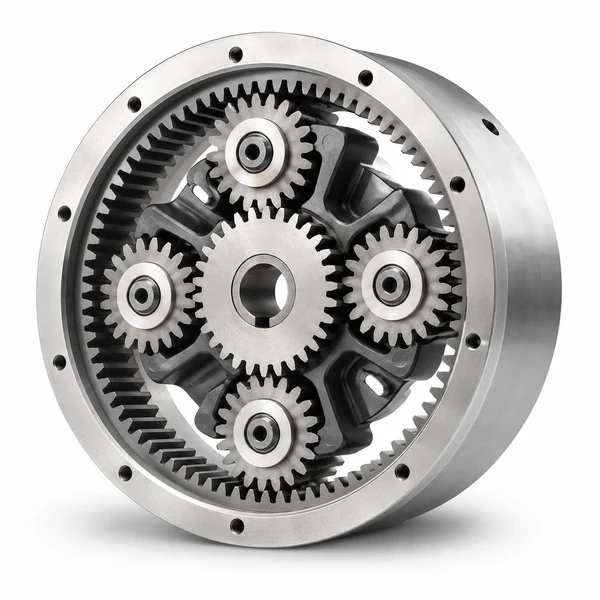
Custom Epicyclic Gear Set
Matched sun, planet and internal ring gear scope for a drawing-led epicyclic transmission RFQ.
Product family
Matched sun, planet and ring-gear projects reviewed as a complete epicyclic mesh system. RFQs should identify the input, output and restrained member, duty cycle, envelope, interfaces, material controls and inspection expectations.
Category overview
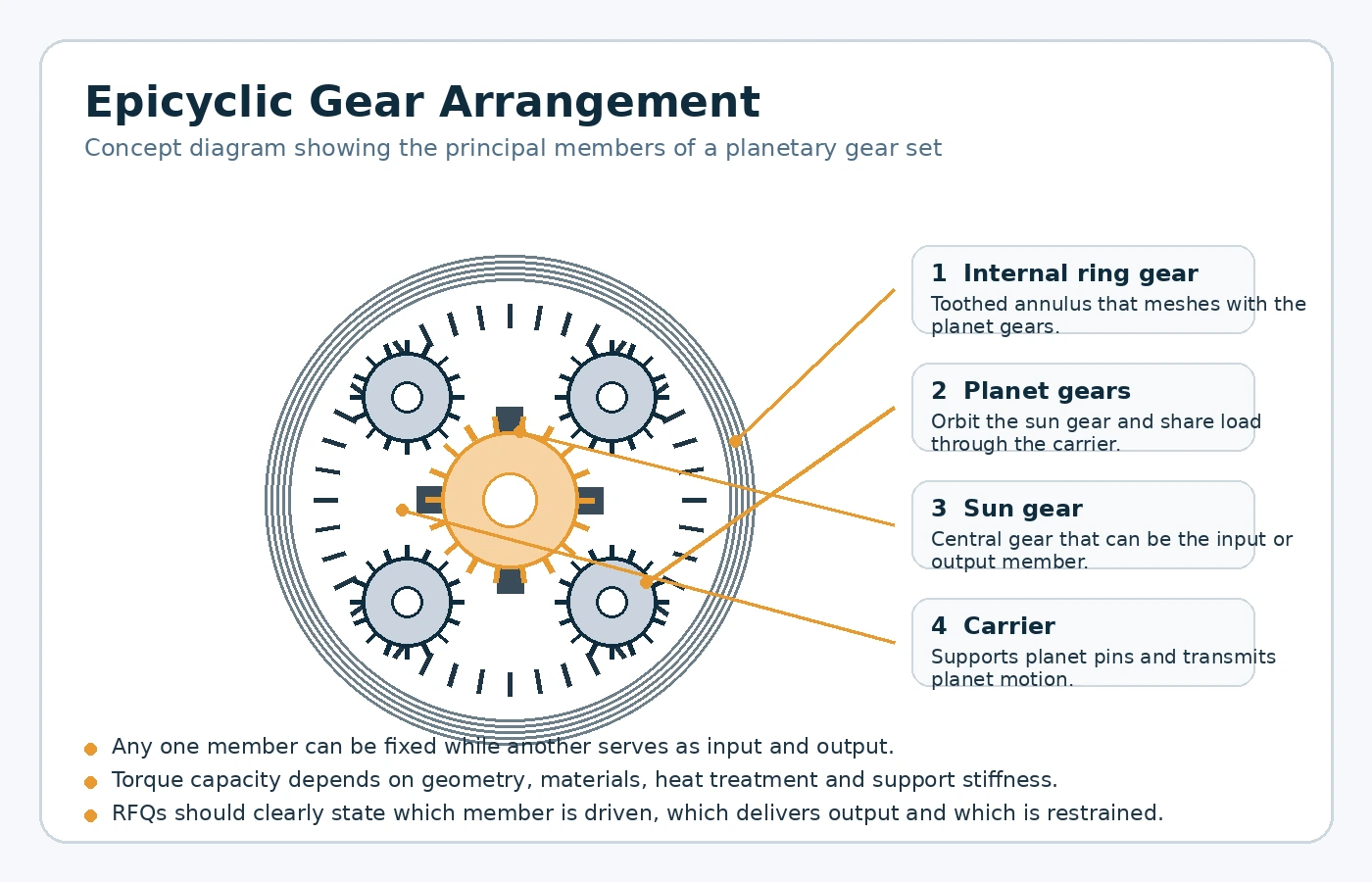
Planetary gear sets must be reviewed as one coordinated mesh system. Tooth geometry, planet spacing, carrier support, member roles and inspection methods affect the complete assembly rather than one isolated gear.
RFQ product range
Select a product family to review its drawing inputs, mating relationships, duty questions and inspection planning.
Matched sun, planet and internal ring gear scope for a drawing-led epicyclic transmission RFQ.
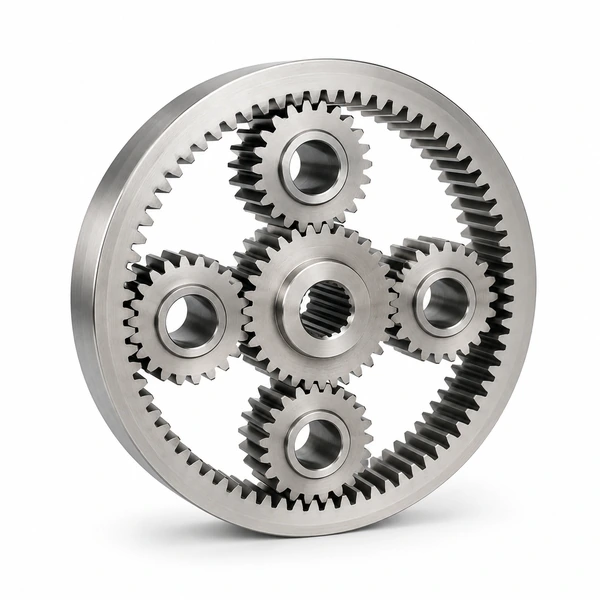
External sun and planet gears reviewed for mesh compatibility, carrier support and duty.
Application context
Compact coaxial drives for reversing, indexing and positioning duties where motor inertia, torsional behavior and interface accuracy must be considered together.
Travel, wheel, swing and drum functions that require shock-load, sealing, bearing support and installation-envelope review.
Mixers, packaging lines, indexing tables and custom production equipment requiring compact multi-stage reduction.
| Data group | Information to provide |
|---|---|
| Member relationship | Identify the input, output and restrained member for every operating mode. |
| Ratio and stages | State target ratio, allowable stages, rotation direction and available axial/radial envelope. |
| Tooth system | Provide module or DP, pressure angle, tooth counts, face width, profile/lead controls and mating data. |
| Carrier and pins | Clarify whether the carrier, planet pins, bearings and retention features are inside the supplier scope. |
| Duty | Describe continuous, peak, reversing, shock and emergency events with speed ranges. |
| Acceptance | Define backlash, contact, runout, gear inspection and assembly records required at release. |
No reliable configuration can be selected from ratio alone. State which member is driven, which delivers output and which is fixed or controlled.
When tooth-thickness allocation, planet spacing or contact behavior is controlled at assembly level, the RFQ should identify the gears as a matched set and define the acceptance basis.
It can be included or excluded, but the RFQ must state the boundary. Planet-pin support, bearings, retention and carrier stiffness still influence the gear review.
Engineering enquiry
Attach the drawing or assembly sketch and identify the controlled geometry, interfaces, operating duty and required inspection records.