Application engineering
Planetary Gearing Application Contexts
Application names are a starting point, not a substitute for load, motion, interface and environmental data.
Compact motion-control systems
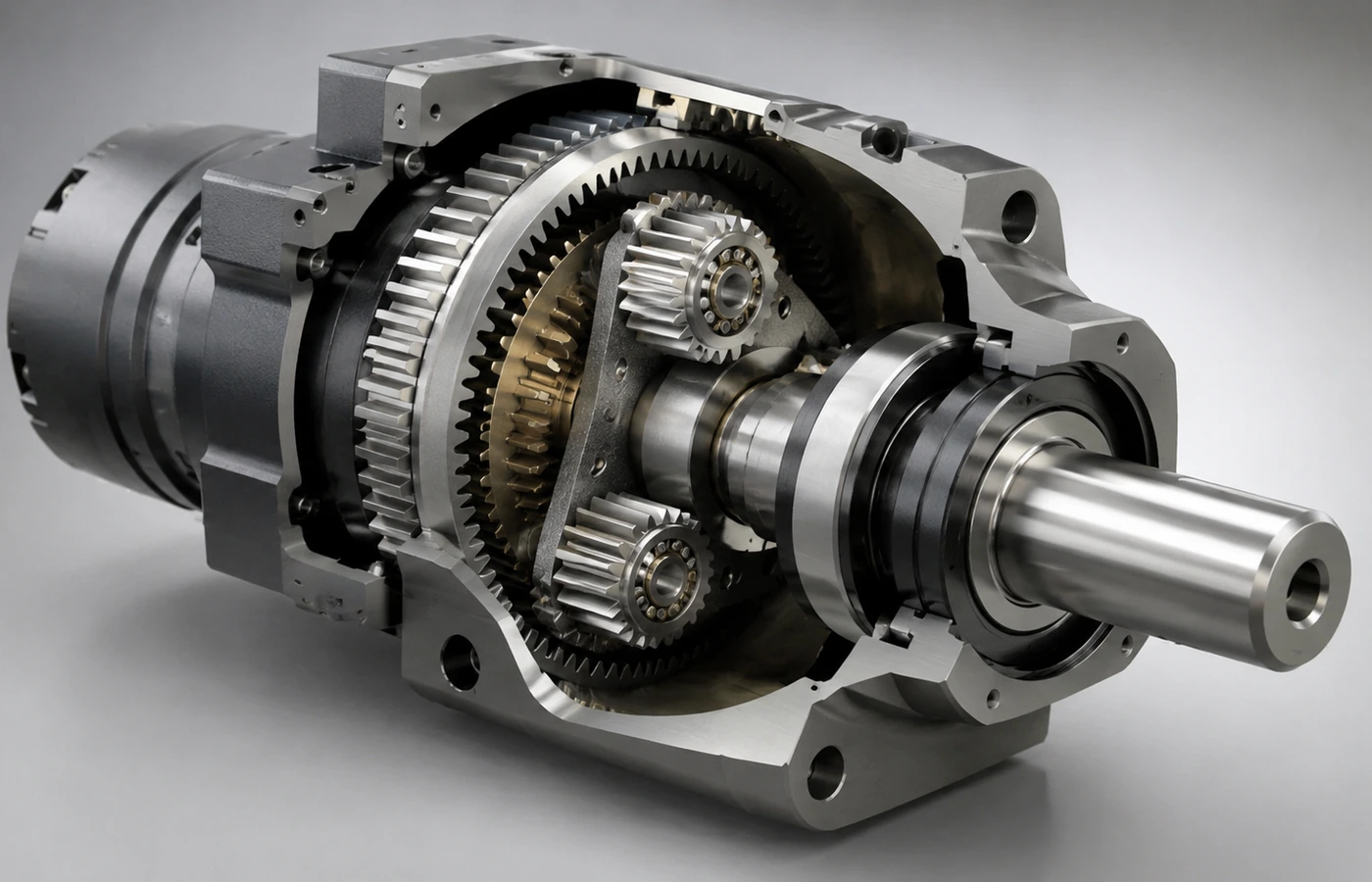
Automation axes can combine frequent reversing, low-speed positioning, acceleration events and restricted installation space. A useful RFQ describes the motor, reflected load, cycle profile, acceptable lost motion, output support and mounting arrangement. The same word—robotics—can describe duties that differ radically in size, speed and service expectation.
For new designs, review gearbox torsional behavior together with the motor and control loop. For replacement work, identify the existing flange, shaft, pilot, fastener pattern and allowable axial length before discussing a nominal ratio.
Mobile, lifting and material-handling equipment
-
Travel and wheel drives
Provide wheel or sprocket interface, vehicle mass context, grade or drawbar duty, shock events, braking arrangement and environmental exposure.
-
Swing and slew functions
Define rotating inertia, acceleration, holding or braking needs, mounting orientation, external bearing support and duty cycle.
-
Drum and mixer drives
State continuous and starting load behavior, drum support, input motor or hydraulic drive, contamination and service access.
-
Winch and hoist integrations
Clarify drum geometry, rope layers, holding concept, safety architecture and whether the gearbox supplies structural support.
Process machinery and custom equipment
Mixers, indexing equipment, packaging machinery, test rigs and production systems often use planetary layouts because a coaxial package can simplify the machine envelope. The quotation still depends on the exact input and output interfaces, radial and axial loads, thermal context, lubrication plan and acceptance method.
| Application question | Engineering input |
|---|---|
| What does the gearbox support? | Separate transmitted torque from external radial, axial and overturning loads. |
| How does the machine start and stop? | Describe acceleration, braking, reversals, jams and emergency events. |
| What is fixed? | Identify the sun, ring or carrier member that is restrained or controlled. |
| How will it be installed? | Provide mounting face, pilot, fastener, orientation and available access. |
| How will it be accepted? | List dimensional, noise, contact, runout or functional checks required by the buyer. |
Engineering enquiry
Describe the machine, not only the ratio
A machine-level description helps identify hidden loads, holding requirements, interface conflicts and service constraints before the gear set is released.
- Drawing or assembly sketch
- Duty and interface summary
- Quantity and inspection needs